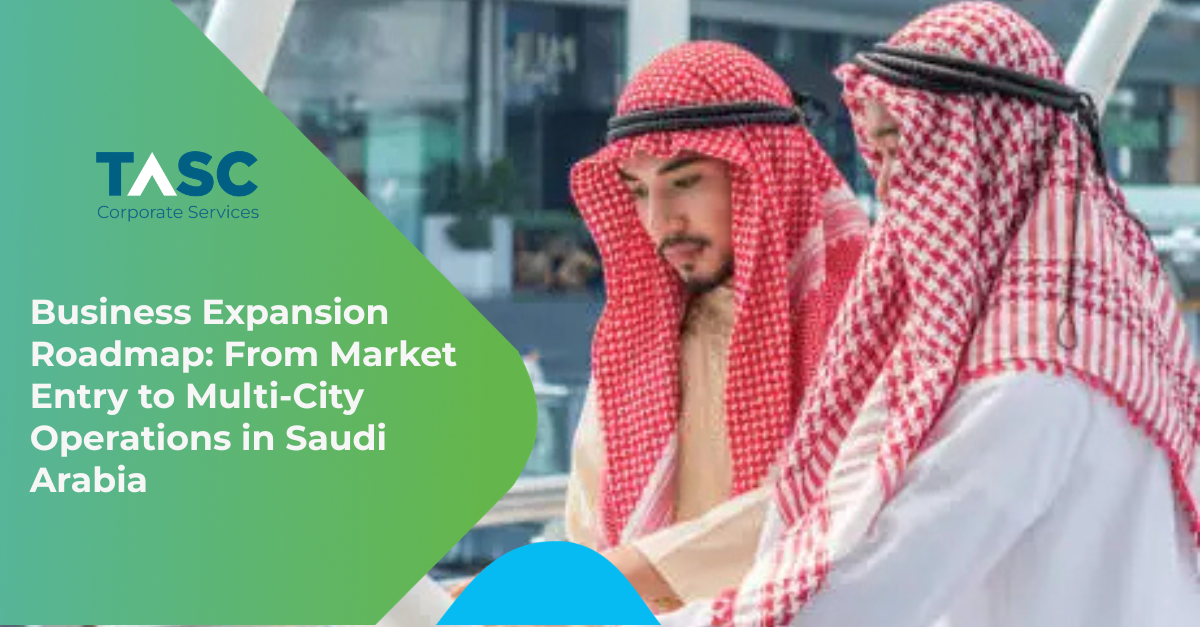
Business Expansion Roadmap: From Market Entry to Multi-City Operations in Saudi Arabia
Business Expansion Roadmap: From Market Entry to Multi-City Operations in Saudi Arabia
Looking at expanding your business into the Kingdom of Saudi Arabia will expose you to one of the fastest-growing markets in the world. Whilst a large part of the country's growth is due to the economic targets set out by Vision 2030, the Kingdom has also welcomed international brands and simplified corporate legislation. However, different from your initial operation through the first location, it can be the management of multiple offices in various regions or cities and will require a step-by-step, very careful approach.
The first thing to know for international brands looking to set up a business in KSA is that the growth that accounts for success doesn't occur out of nowhere in a single day, or even over a couple of weeks or months. It mainly entails having a definite strategic plan that starts from the top with the legal groundwork in a big main city, moves on to operational deployment and finally is rolled out to other commercial cities.
Stage 1: Establishing the Primary Legal Footprint
Claiming the right to operate as a foreign investor in Saudi Arabia will be your first legal step. You cannot, however, engage in activities like leasing commercial spaces or recruiting staff in any Saudi city until your legal status is obtained.
The acquisition of an Investment Registration Certificate issued by the Ministry of Investment of Saudi Arabia (MISA) is what initiates the growth journey. Your recognition as a business owned by foreign investors will be officially verified once you obtain this certificate. Apart from that, remembering to reserve your trade name and to get your main Commercial Registration (CR) from the Ministry of Commerce are equally important steps.
A majority of businesses that are planning to expand choose to have their main corporate center in either Riyadh or Jeddah, as these cities have the greatest access to their various resources, personnel, business facilities, and access to local as well as international markets. The first office will be your operational administration center, and this is where you will also perform your initial tax filings with the Zakat, Tax and Customs Authority (ZATCA).
Stage 2: Local Operations and Core Team Development
Once you have your main CR, the subsequent step is to construct a solid, effective corporate machine. This step will revolve around securing your business in the city of your pilot launch before going forward with the risks of supplying the geographic expansion.
- Activation of Platforms: You have to connect your CR to the national labor platforms, mainly Qiwa and Muqeem. These portals are in charge of your corporate visa quotas and your employee contracts.
- Workforce Stabilization: You have to make your recruitment according to the Nitaqat program, which stipulates that a certain percentage of the workforce must be Saudi nationals. Keeping a "Platinum" or "High Green" compliance status will guarantee that your business processes in government requests get the highest priority.
- Operational Cash Flow: You need to link your sales channels with the national mandatory electronic invoicing system (Fatoora) to make sure that every transaction fulfils the requirements of local financial transparency regulations.
Stage 3: Branching Out to Secondary Cities and Regional Markets
Once your primary location runs smoothly and turns a profit, you can execute your multi-city expansion plan. Saudi Arabia's diverse economy means that different regions offer unique commercial advantages.
To operate legally in a new city, you do not need to start the entire MISA registration process from scratch. Instead, you apply for a "Sub-CR" under your main corporate file through the Saudi Business Center portal. Each new branch office requires a local municipal license (Baladiya) and a unique physical address verified by Saudi Post (SPL).
Opening a branch in the Eastern Province (such as Dammam or Khobar) provides direct access to the industrial, logistics, and energy sectors. Meanwhile, expanding into the Western Province (Jeddah or Makkah) connects your brand to major retail, tourism, and maritime logistics networks.
Structural Requirements for Multi-City Expansion
Managing multiple operations across different provinces introduces new administrative tasks. The table below outlines the core requirements you must meet as your business grows from a single office into a multi-city enterprise.
|
Expansion Element |
Single-City Requirements |
Multi-City Enterprise Requirements |
|
Commercial Registration |
One Main CR tied to your principal city. |
A primary CR supported by individual Sub-CRs for each secondary branch city. |
|
Address Verification |
One National Address (SPL) for the main office. |
Unique registered physical addresses for every active commercial storefront or office. |
|
Labor Management |
A single unified corporate file on the Qiwa platform. |
Segmented branch accounts under the main Qiwa file to track local hiring scores across regions. |
|
Municipal Licenses |
One Baladiya permit from the local municipality. |
Independent municipal permits for every location to satisfy local safety and signage rules. |
Partner With TASC Corporate Services for Seamless Multi-City Expansions and Turnkey Corporate Growth
Managing Sub-CR applications, unique local municipal permits, and regional labor scores across multiple Saudi cities can strain your internal operations. Partner with TASC Corporate Services for a structured, reliable roadmap to scale your business across the Kingdom. Our on-the-ground corporate specialists manage the entire expansion process—from securing regional business registrations and local municipal approvals to aligning your branch offices with national labor rules. We eliminate administrative errors and regulatory delays, allowing your business to enter new regional markets smoothly and legally. Let TASC handle the complex corporate compliance details while you focus on capturing market share. Contact TASC today to accelerate your regional growth.
Frequently Asked Questions
Do I need a new MISA license to open a branch office in a different Saudi city?
No. Your primary MISA investment registration covers your entire corporate presence within the Kingdom. To expand to a new city, you only need to log into the Ministry of Commerce portal and apply for a Sub-Commercial Registration (Sub-CR) linked directly to your main corporate entity.
Can a foreign business manage multiple city branches using a single corporate bank account?
Yes. You can use your primary corporate bank account to manage the revenues, payroll, and expenses of all your regional branches. However, for clear accounting and internal audits, businesses usually set up separate sub-accounts or unique cost centers for each city branch.
How does opening a regional branch affect my company's Nitaqat compliance score?
The Ministry of Human Resources evaluates your Nitaqat (Saudization) compliance based on the total number of employees registered under your main corporate file. However, your staff counts across all branches are combined, meaning a hiring deficit in a new branch can lower your overall corporate compliance score.
Is it legal to operate a regional branch out of a virtual office space?
While virtual offices are acceptable for certain types of initial business setups, regional economic departments usually require a physical, verified office space to issue a branch municipal license (Baladiya). This is especially true for businesses involving retail, trade, or logistics.
What are the financial penalties for running an unregistered branch office in a secondary city?
Operating a commercial facility without a valid Sub-CR and a local municipal license violates market rules. If discovered during regular government inspections, the business can face direct financial fines, temporary closure of that specific branch, and a temporary hold on its main visa portal.