Why Enterprise Payroll Governance Is Becoming a Board-Level Priority in the UAE
For a long time, business leaders viewed payroll as a basic back-office chore. It was seen as a routine monthly task focused on tracking hours, running numbers, and sending bank files. However, across the UAE, executive boards and business owners are taking a direct interest in how workforce compensation is handled.
This shift from an administrative duty to a board-level priority is driven by major legal changes. Over the past few years, the UAE has rolled out federal corporate tax, updated strict local hiring targets, and automated government tracking systems. Because these systems connect directly to ministry databases, a minor salary error is no longer just a small internal mistake. Today, poor payroll oversight can lead to heavy corporate fines, frozen government accounts, delayed expansion plans, and legal risks for company directors.
The Divergence Between Mainland and Free Zone Frameworks
A big reason payroll governance has grown so complex is the distinct legal setup in the region. Understanding payroll differences UAE businesses deal with means looking closely at how different jurisdictions operate:
Mainland Payroll Rules
Companies registered on the mainland fall under the direct regulation of the Ministry of Human Resources and Emiratisation (MOHRE). The legal UAE employee payroll compliance setup here centers around the Wages Protection System (WPS). Under this system, salary amounts, allowance breakdowns, and payout dates must match registered labor contracts exactly. If recorded contractual pay does not match the actual bank transfer, government systems automatically flag the company profile.
Free Zone Payroll Frameworks
Entities operating within free zone payroll UAE hubs follow rules set by their specific local authority. While free zones offer streamlined business setups, their payroll systems often run parallel to mainland rules. Furthermore, free zones like DIFC and ADGM have introduced independent workplace savings schemes for end-of-service benefits, which require monthly employer payments rather than traditional lump-sum calculations.
Managing both mainland payroll UAE rules and free zone setups under a single corporate group requires strict, standardized oversight.
Escalating Regulatory Risks and Executive Accountability
Board members are stepping in because the financial and operational risks of breaking UAE labour payroll rules have increased dramatically.
Key pressure points catching boardroom attention include:
- Corporate Tax Audits: Under the federal corporate tax system, salary expenses make up one of the largest tax-deductible items on a balance sheet. Board-level governance ensures that salary registers, general ledger records, and bank statements align perfectly to pass tax audits.
- Nationalization Mandates: Compliance with Emiratisation quotas is tracked continuously through connected digital portals. Missing these targets leads to automatic monthly fines per unfilled position, along with potential downgrades in company status.
- Systemic Portal Locks: When payroll files fail validation or miss monthly deadlines, government portals are automatically locked. A portal lock stops a business from getting work permits, renewing trade licenses, or executing expansion plans.
Building a secure enterprise payroll UAE setup protects companies from these compounding risks.
Core Pillars of Board-Level Payroll Governance
To protect the organization, executive teams must build a resilient payroll operating model UAE enterprises can easily defend under official audit. A reliable framework relies on three simple pillars:
1. Dual-Level Authorization Controls
Enterprise setups must enforce clear segregation of duties, often called "maker-checker" controls. Local entity HR or payroll specialists enter monthly data, but final sign-off rests with senior finance leaders. This step stops unverified salary edits, controls overhead costs, and cuts down on internal errors.
2. Integrated Software Systems
Relying on manual data entry across scattered spreadsheets is the fastest way to trigger government penalties. Board-level oversight pushes for direct connections between time-tracking tools, accounting software, and bank transfer tools. Automated workflows ensure that variable pay, sales bonuses, and unpaid leave calculations follow legal guidelines accurately.
3. Continuous Internal Audits
Rather than waiting for end-of-year tax reviews, modern governance setups run quarterly internal reviews. These checks verify that end-of-service benefit accruals match current basic salary rates, employee data across subsidiary entities stays accurate, and all pension contributions are paid on time.
Strengthening Strategic Oversight and Risk Mitigation
As the corporate environment matures, board members recognize that payroll failures represent real business risks that can hurt company value and stakeholder trust. When a multi-entity business faces payment bottlenecks, the problems go far beyond late paychecks. Delays can cause immediate labour disputes, higher turnover, and bad standing on official business registers.
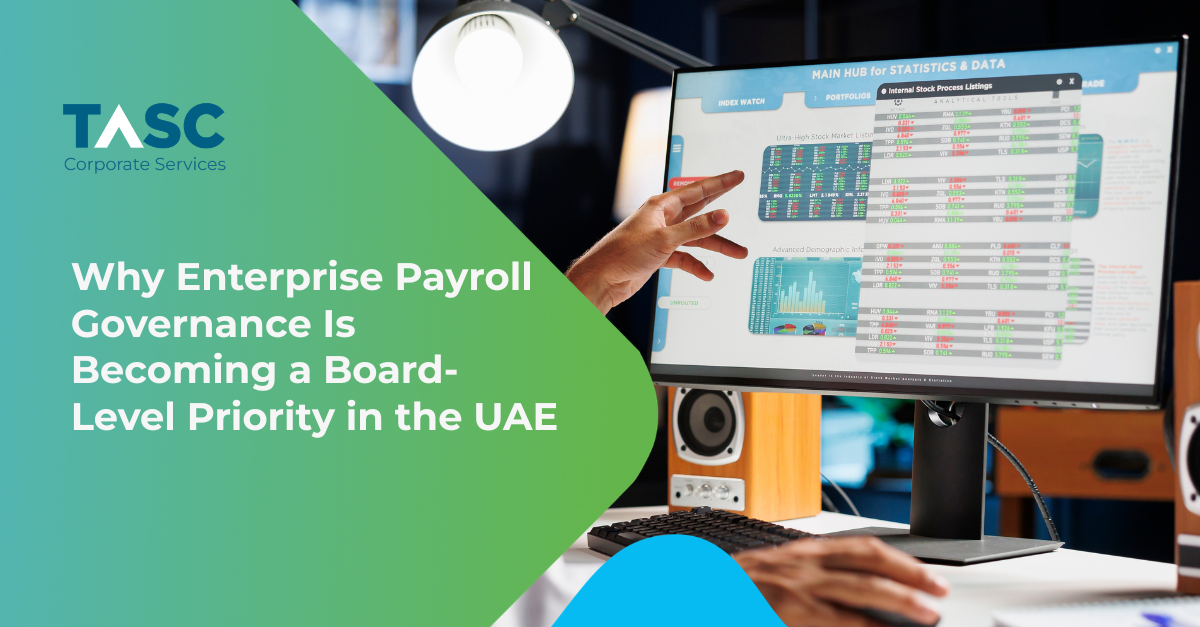
To counter these risks, executive boards are adopting real-time monitoring dashboards. These specialized tools pull workforce data from all subsidiaries, whether located in free zones or on the mainland, giving leadership a clear view of upcoming payment dates, statutory filing windows, and local hiring compliance scores.
Shifting from reactive error-fixing to continuous strategic oversight allows boards to protect company profits while building a strong reputation as an employer of choice. Establishing a clean payroll framework ensures that expansion across multiple UAE entities proceeds smoothly, backed by total legal compliance and financial integrity.
Frequently Asked Questions
Why has payroll governance become a board-level issue in the UAE?
Because non-compliance now carries major risks, including steep financial fines, blocked government accounts, tax audit scrutiny, and damage to corporate reputation.
What are the main differences between mainland and free zone payroll?
Mainland companies must process salaries through the government-monitored Wages Protection System (WPS) under MOHRE rules. Free zone entities follow their specific zone authority rules, with some requiring monthly workplace savings contributions instead of traditional gratuity accruals.
How does an enterprise payroll framework protect leadership?
It creates clear approval steps, restricts system access based on staff roles, creates automatic audit records, and connects HR data directly with accounting software to ensure operations meet legal standards.
How do nationalization quotas affect payroll tracking?
Emiratisation targets require real-time tracking of local hires, basic salary limits, and pension contributions. Missing targets triggers automatic monthly fines per role, making accurate tracking essential.
How does proper payroll governance support corporate tax compliance?
Since wage costs are a major corporate tax deduction, clean payroll records ensure that all claimed expenses are accurate, categorized properly, and backed by matching bank transfer files.