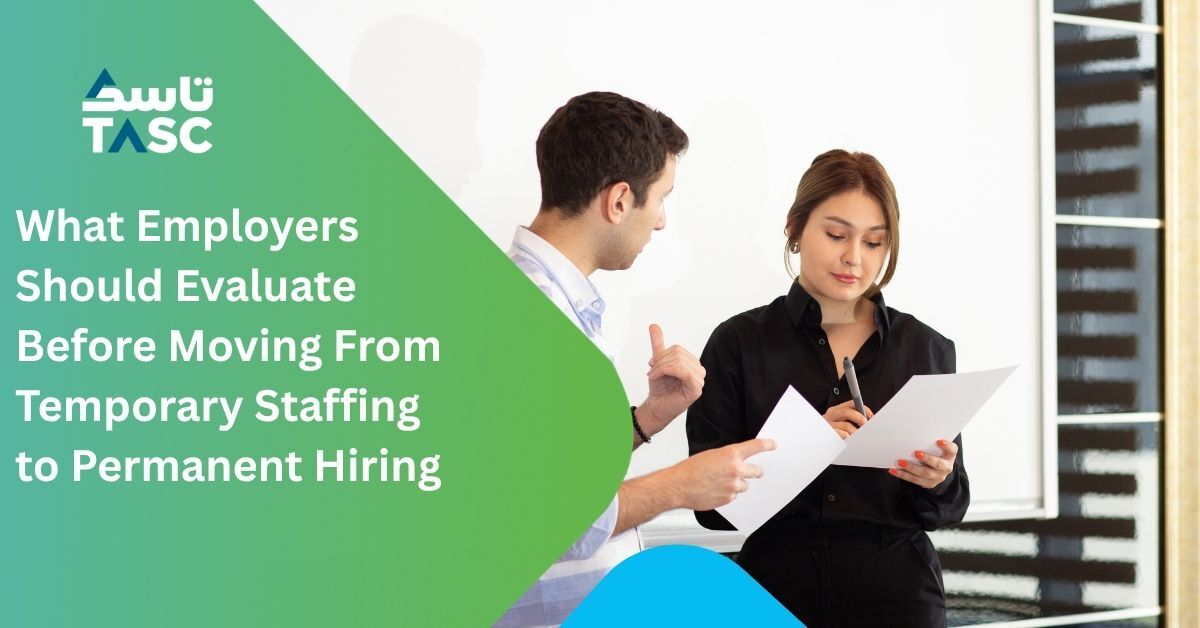
What Employers Should Evaluate Before Moving From Temporary Staffing to Permanent Hiring
Moving a temporary worker to a permanent role is a big step for any growing business. Temporary staff help you handle busy seasons and short projects. But as the business grows, you may need a steady team that stays for the long term.
This decision should not be rushed. In the UAE, a permanent employee brings financial, legal and operational commitments that a temporary worker does not. Before you make the change, it is worth checking whether your business is truly ready. Here are the main points to review.
Demand Sustainability
The main reason to hire full-time is steady, long-term demand. Start by checking whether your extra workload is a short spike or a lasting change in your business.
Consider these questions:
- Is the workload seasonal? If the extra work comes from holiday sales, annual events or project cycles, continuing with a temporary staffing agency is usually the more sensible choice.
- Has demand stayed high for 6 to 12 months? If customer numbers, repeat revenue or daily tasks remain high long after the peak, a permanent hire becomes easier to justify.
- Will the role exist in two years? A permanent job should meet a lasting business need, not a short-term gap.
Cost of Permanent Employment vs. Temporary Staffing
Many employers believe temporary staff cost more because of the agency fee. On paper, the daily or hourly rate for a temp does look higher. However, a full-time employee brings ongoing costs that are easy to overlook.
In the UAE, moving someone onto your payroll means you take on the following:
- Visa and onboarding: You must arrange a company-sponsored visa, a work permit and a medical fitness test.
- Health insurance: You must provide cover for as long as the person works for you.
- End-of-Service Gratuity (EOSG): This builds up the longer an employee stays with your company.
- Other benefits: Annual flight allowances and paid leave add to your fixed costs. So can the cost of letting people go if business slows down.
With a licensed temporary staffing company, these costs sit inside one service fee. Before you switch, work out the total cost of the role over time. Make sure your regular income can carry it comfortably.
Operational Flexibility
The biggest strength of temporary staffing is flexibility. You can grow or shrink your team as your needs change. Once a role becomes permanent, you give up some of that freedom.
Think about how much your workload moves from month to month.
- If demand changes often, temporary staff let you scale down without severance pay, notice periods or extra paperwork.
- If demand is steady, permanent staff make more sense. Many companies use a mix: a core team of permanent employees, supported by temporary staff during busy periods. This protects your margins when the market changes.
Ask yourself whether your business can afford to lose some flexibility. If the answer is not clear, it may be better to wait.
Skills and Cultural Fit
Temp-to-hire is one of the safest ways to make a permanent hire. You already know how the person works, so there is much less guesswork than when hiring a stranger.
Before you make an offer, ask yourself:
- Do they perform well? Are they reliable, skilled and productive every day?
- Do they fit in? Do they share your values and work well with the team?
- Can they grow? Could they take on more than their current duties in the future?
A temp-to-hire arrangement helps you answer these questions with real evidence. You see how the person works in real conditions before you sign a permanent contract. It also saves time, since the person already knows your systems and processes.
Compliance and HR Capacity
Hiring permanently means dealing with labour laws, visa rules and payroll systems. In the UAE, this includes following the Ministry of Human Resources and Emiratisation (MOHRE) regulations and the Wage Protection System (WPS) standards.
Ask whether your HR team has the time to handle visa processing, payroll and daily employee matters on its own. If it does not, working with a recruitment agency in the UAE can lift much of that load and keep every step compliant. This is especially useful when you are converting several temporary workers at once.
Partner With TASC Outsourcing
Going for a permanent hiring option when demand is stable, the costs are known, and there is certainty about the candidate being a good fit makes a lot of sense. However, when none of these things is certain, it is best to remain flexible for some time more.
No matter whether you want additional staff on a temporary basis or are looking to have a permanent team in place, a recruitment partner can help you save your time and ensure that you stay compliant at all times. TASC Outsourcing is a recruitment firm based in the UAE, which provides temporary staffing, contract management, and permanent executive recruitment services. They help companies expand without squeezing their profit margins by giving them access to an already vetted database of 1.5 million candidates in 68 nationalities.
Get in touch with TASC Outsourcing and speak with a staffing expert today.
Frequently Asked Questions
What is the main benefit of converting temporary staff to permanent employees?
You get a more stable team. The employee already understands your business, so you keep that knowledge and avoid training someone new. Long-term staff also tend to be more engaged.
What is a temp-to-hire arrangement?
You hire someone through a temporary staffing agency, with the option to move them onto your payroll later. During that time, you can check their skills, performance and fit with your culture.
How can employers avoid hiring too many permanent staff?
Keep your permanent team small, just enough for your regular workload. Use temporary staff for busy seasons, special projects and short-term peaks.
How long should I wait before making a temporary worker permanent?
There is no fixed rule, but many employers wait until demand has stayed steady for 6 to 12 months and the person has shown consistent results.